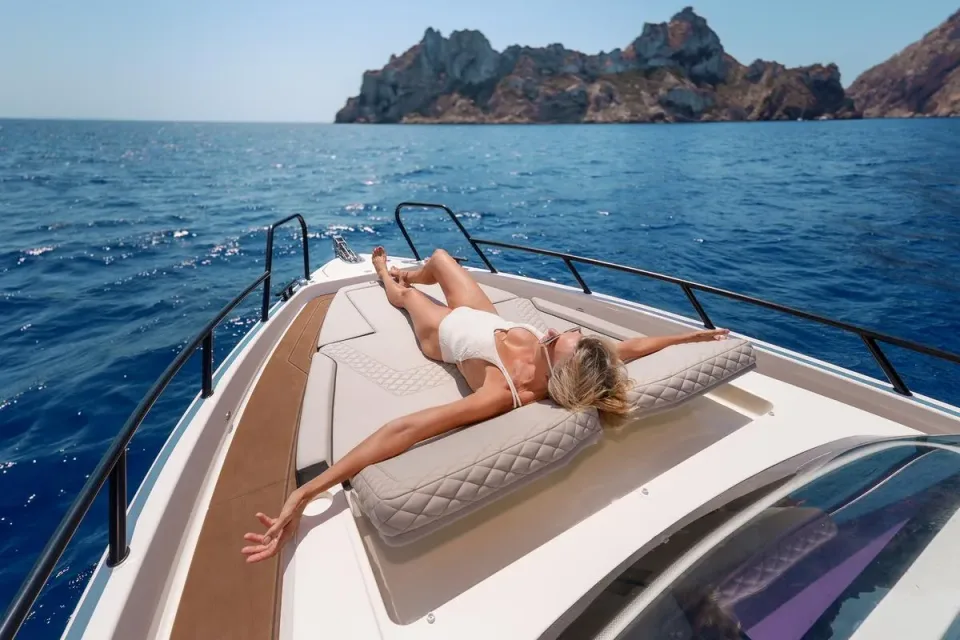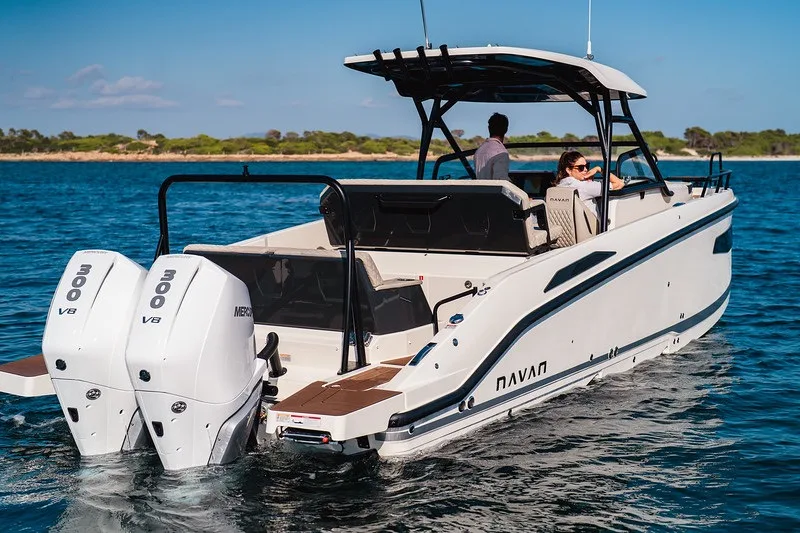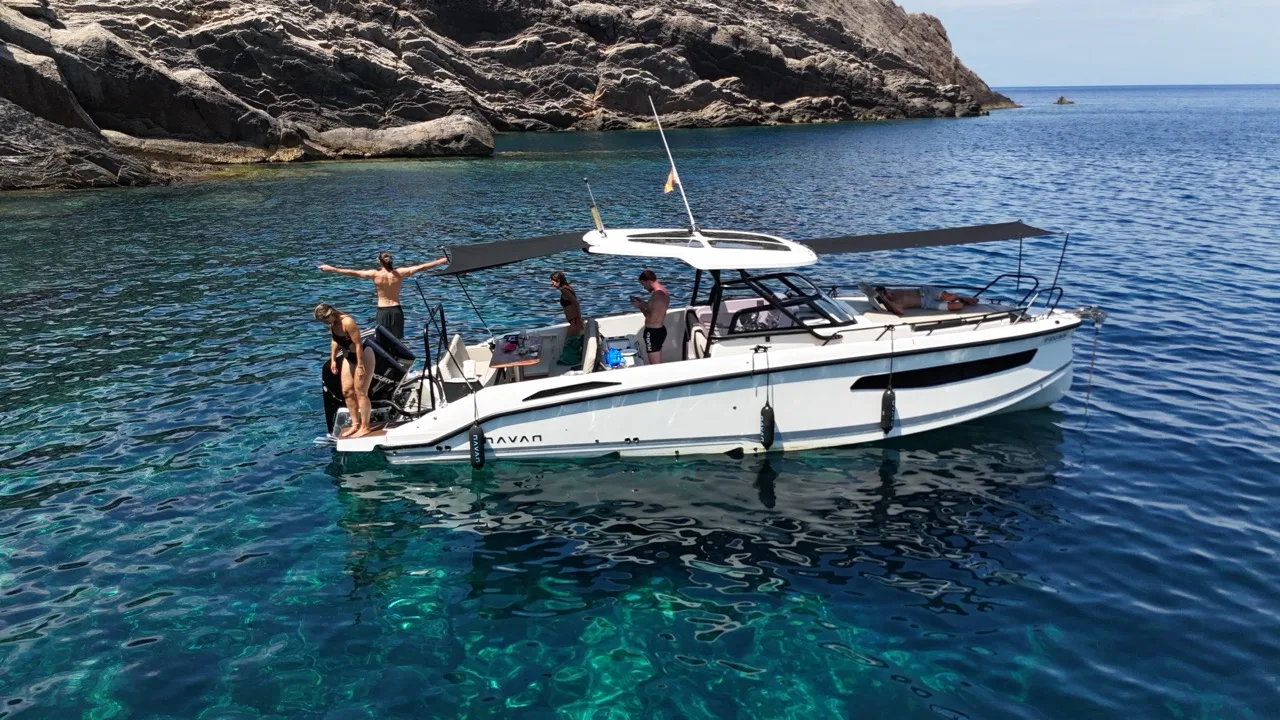
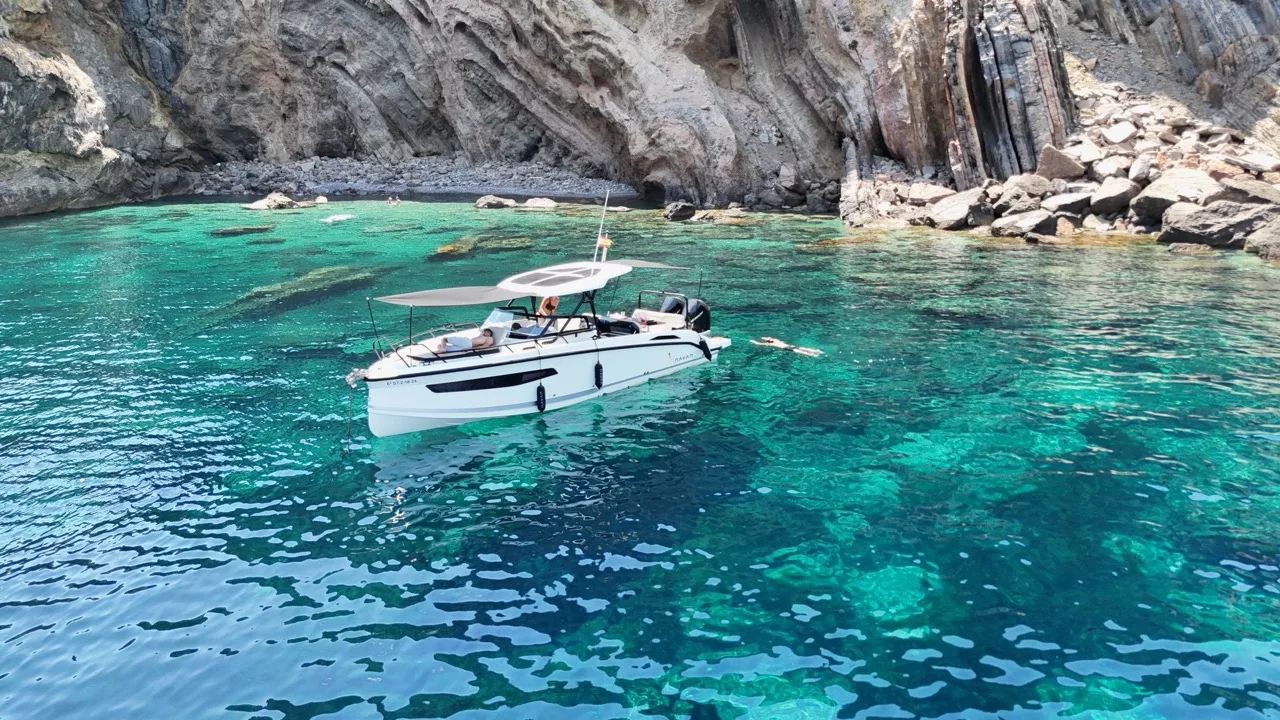
Atlantis does not appear on any official map of Ibiza. Look for Sa Pedrera de Cala d'Hort instead: a centuries-old sandstone quarry on the island's southwest corner, carved into geometric blocks, ledges and turquoise pools, with Es Vedrà filling the horizon in front of it. Ask anyone who has visited Atlantis Ibiza on foot and they will talk about the path before the place — a steep, unofficial descent of almost 200 metres, 30–45 minutes down and 45–75 minutes back up over loose dirt and sand, without a metre of shade. From the deck of our NAVAN S30, the same visit is the rattle of an anchor chain and a short swim. This is our honest guide to Atlantis, its silent neighbour Cala Llentrisca, and the protected islets you may circle but never set foot on.
What Atlantis Ibiza actually is: a quarry, not a myth
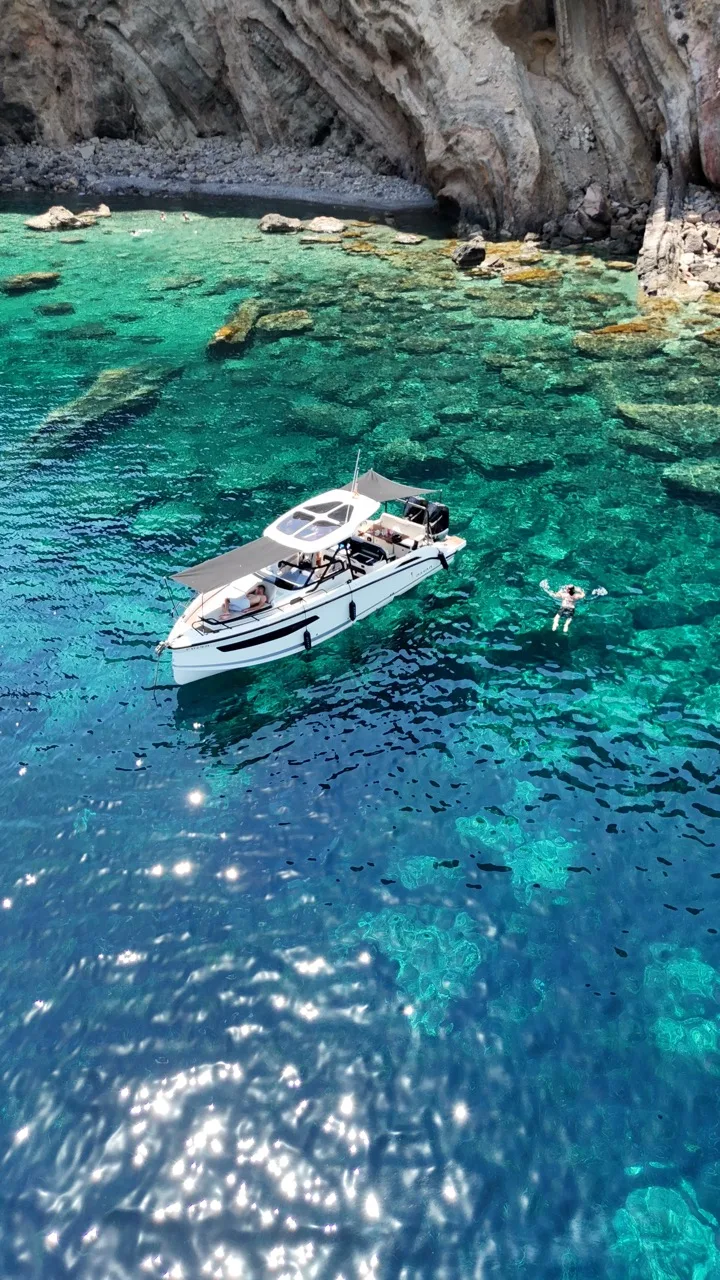
For centuries, stone-cutters sawed building blocks out of this ledge of coast, and what they left behind reads like sunken architecture: right-angled cuts, squared platforms stepping down into the sea, pools of still turquoise water trapped in the rock. That geometry is where the "sunken Atlantis" nickname comes from. The counterculture years added their own layer — carvings in the soft sandstone, including a well-known Buddha relief that swimmers still seek out. There are no services of any kind: no bar, no sunbeds, no shade beyond what the rock itself throws. Whatever you need, you bring — which is easy when the boat floats a few metres off with a cool box, snorkeling gear and a private toilet below deck.
The climb versus the anchor chain
We will be straight with you: Atlantis can be reached on foot, and determined hikers do it every week. But the honest verdict is tough. The unofficial path drops almost 200 metres, the surface is loose dirt with a dune section, there is no shade anywhere, and it is explicitly not recommended for anyone with vertigo or average fitness. Going down takes 30–45 minutes; the climb back up, in full afternoon sun, 45–75. From the water, all of that simply disappears. Our skipper anchors off the quarry, the ladder goes down, and you swim straight into the pools with a mask on. Of all the places in our guide to Ibiza's boat-only beaches, this is where the gap between land and sea access is at its starkest.
Cala Llentrisca: boathouses, pebbles and posidonia shadows
A short hop east lies Cala Llentrisca, perhaps the quietest anchorage of the whole southwest. On land, the visit starts at the gatehouse of the private Es Cubells urbanization — the guards do let cove visitors through — then you park at a small plaza and walk the final 800 metres or so on an unsigned trail. The alternative is a 40–60 minute coastal hike from Ses Boques. By boat, it is one of the easiest quiet stops on this coast. The reward is a pristine pebble cove where the only buildings are a row of traditional fishermen's boathouses: no bar, no sunbeds, not even a sign. Tucked under Cap Llentrisca it takes good shelter from westerlies and opens roughly southeast; the water is glass-clear over pebbles, rock and posidonia meadows, so our skipper drops the anchor on a clear sand patch and lets the boat hang above the green.
Es Vedrà and Es Vedranell: circle them, never land
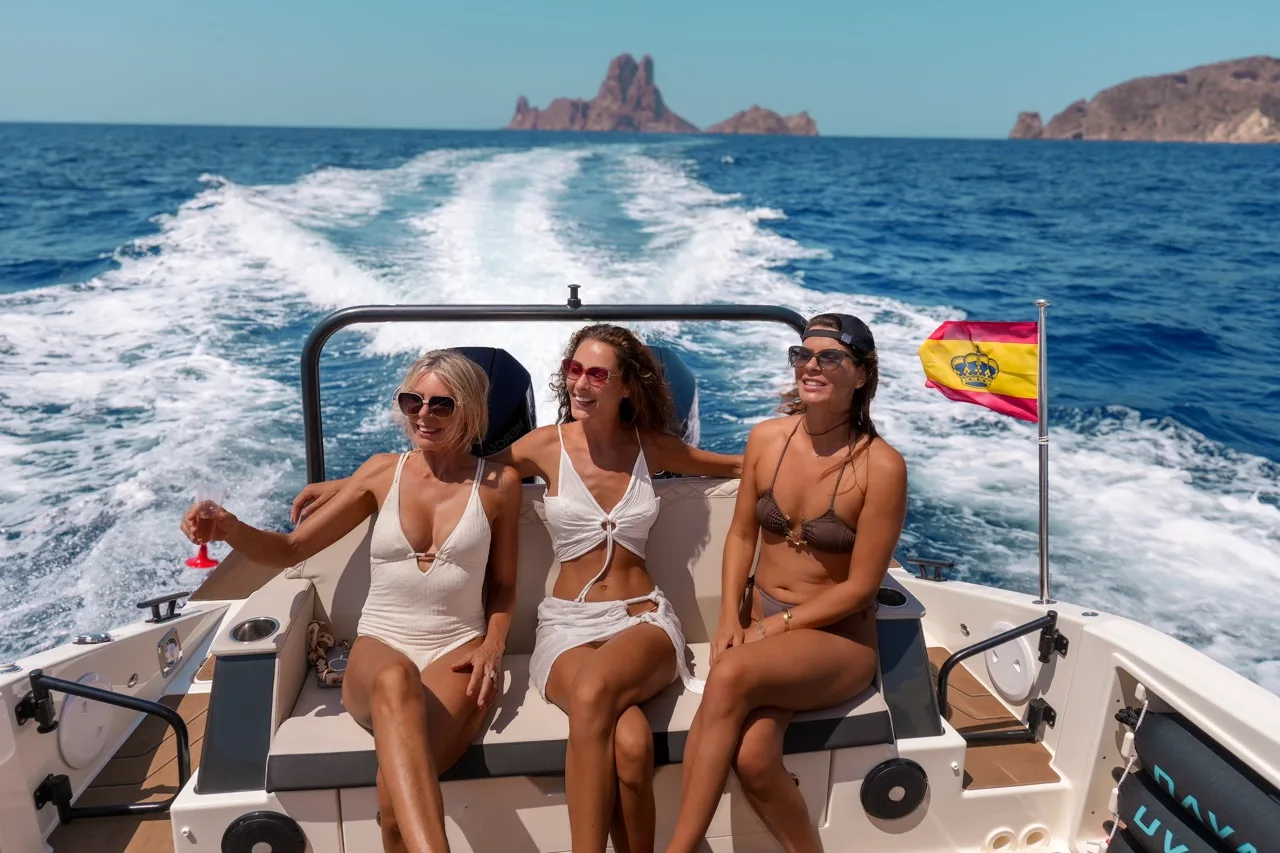
The amphitheatre around Atlantis is completed by two islets. Es Vedrà is the one you know from photographs: a limestone monolith rising some 380 metres sheer from the sea, wrapped in stories of sirens, the goddess Tanit and magnetic anomalies. Es Vedranell is its lower, more serrated companion. Both belong to the Es Vedrà, Es Vedranell and Illots de Ponent natural reserves, and the rules are simple: sailing their waters is allowed; setting foot ashore without authorization is expressly prohibited. The islets are protected habitat for endemic wall lizards, nesting seabirds and raptors such as Eleonora's falcon. In settled weather the channel between the islets and the Cala d'Hort shore stays sheltered enough for a slow pass, and divers rate the reserve-grade seabed below. We circle the base at walking pace and let the cliffs do the talking — landing is never on the programme, and that rule is a large part of why the place still looks the way it does.
Cala d'Hort, the honest reference stop
No pretending here: Cala d'Hort is fully accessible by road, has traditional fish restaurants behind its sand-and-pebble beach, and draws real crowds in summer. We include it because it earns its role as the reference point of this stretch: a regulated summer anchorage offshore, the classic head-on Es Vedrà panorama, and the natural lunch fallback if your group would rather eat grilled fish ashore than around the teak table on board.
Wind wisdom for the amphitheatre
This whole corner faces west to southwest, and that decides everything. When a westerly swell is running, the quarry pools turn washy, the anchorages get uncomfortable, and we simply take the day to the other side of the island, where the east coast lies flat. The magic days are the calm ones, or days with an easterly Llevant blowing: then the west coast sits in the lee and the sea off Atlantis goes to glass. Llentrisca adds a useful nuance — sheltered from westerlies by its cape and opening southeast, it can still work when Atlantis does not. Reading that balance is our skipper's job, decided on the morning itself with the forecast in hand, not guessed a week ahead.
How we build the day from Santa Eulalia
Our NAVAN S30 leaves Berth H17 in Marina Santa Eulalia at 10:00, runs south past Cala Llonga and the UNESCO-listed silhouette of Dalt Vila, and rounds the southern tip past Es Porroig and Cala Jondal. On a settled day we put the Atlantis swim stop in before the crowds arrive, take lunch at anchor off Llentrisca or ashore at Cala d'Hort, and give the afternoon to a slow circle of the islets. Back at the marina by 18:00 — though later in the season it is worth timing the return for golden hour; we have written separately about where Ibiza's sunset actually works best from the water. For the classic full version of this run, see our Es Vedrà and west coast charter — and if the wind rules this corner out on your date, the secret coves further up the west coast lose nothing in comparison. Pack water shoes for the quarry ledges; leave the reading of the sky to us.