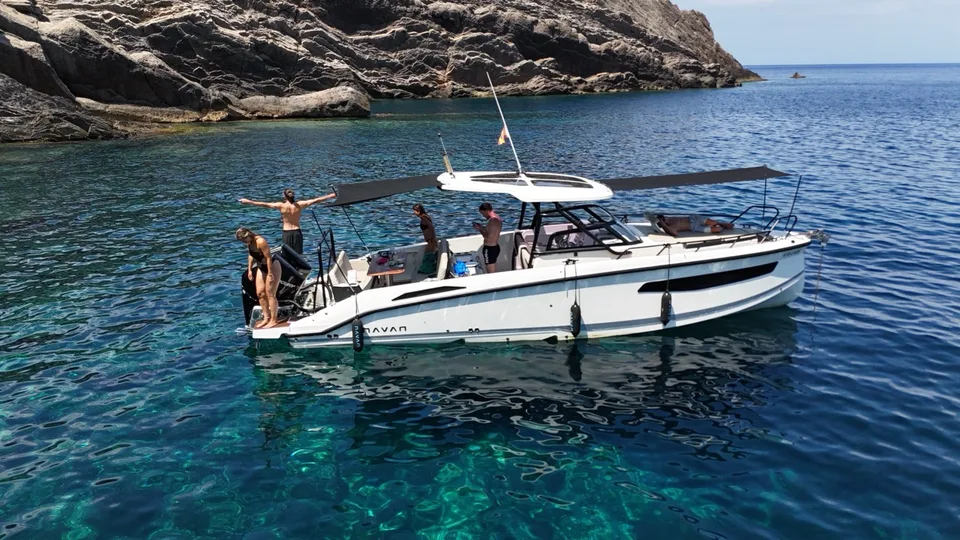
There is exactly one lawful way onto S'Espalmador, and it floats. Wading across the Es Pas channel from Ses Illetes — the "shortcut" that still circulates on social media — is prohibited and genuinely dangerous: the current running through the gap is strong, and red flags stand on the shore to make the point. No public ferry serves the island either, because it is privately owned. Getting to Espalmador by boat is therefore not the comfortable option; it is the only legal one. And that single fact explains why, on an August Saturday when Ses Illetes lies towel-to-towel, the lagoon at s'Alga can still feel half asleep.
We make this crossing from Santa Eulalia all season — Espalmador is the first swim stop on our Formentera day. Consider this guide a chapter in our series on the beaches you can only reach by boat: most coves earn that label through geography, this one earns it through law. Below: how the island really works, the seagrass rules every visitor should know, and honest verdicts on Formentera's "secret" coves — including the ones you could, in truth, walk to.
Why Espalmador by boat is the only way in
At low water, the Es Pas channel between Illetes and Espalmador looks innocent: a few hundred metres of sandy shallows. It is a trap. Crossing on foot or swimming is officially prohibited, and the currents that funnel through the opening are the reason — not a rough-day warning but a permanent rule, flagged in red at the water's edge. Every summer a few people try anyway; every summer some of them need help getting back.
The other half of the story is simpler. Espalmador is private, and the ferries between Ibiza and La Savina do not call here — no public service does. If you are weighing up how to cross to Formentera in general, we have done the honest maths in ferry versus private boat; for Espalmador itself there is no sum to do. You arrive over the water, or you do not arrive.
Platja de s'Alga: where you land, and the rules ashore
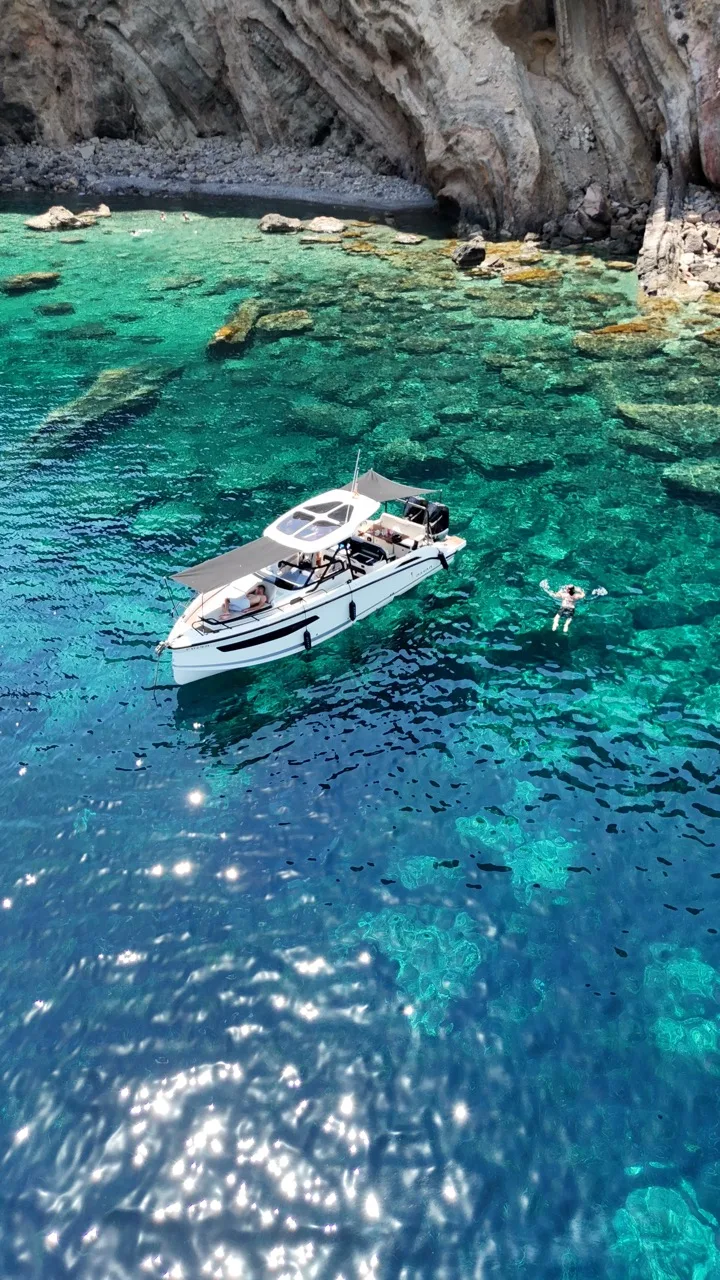
S'Alga is the islet's only true sand beach: a shallow, lagoon-like bay inside the Ses Salines Natural Park, so well sheltered it often stays glassy while the open channel is already ruffled. The moment the engines stop you hear the anchor chain run out — and then very little else. Under the swim ladder you can watch the hull's shadow on the sand.
Let us be straight about the rules, because they matter here: you may land on the beach, but the island behind it is private — walking inland is not permitted. The famous mud baths of years past are also prohibited now. The reward for playing it straight is the beach itself, which rarely feels remotely busy, and swimming that genuinely lives up to the Caribbean comparisons everyone makes. Services: zero. Everything you want ashore comes off the boat.
Sa Torreta: the far side almost nobody bothers with
Around on the north-west shore lies Sa Torreta, roughly 170 metres of virgin sand named for the Torre de sa Guardiola, the 18th-century defence tower standing just behind the dunes. Calm, transparent water over fine sand — and even in August it is usually near-deserted, because the day boats stop at s'Alga and go no further.
The posidonia buoys: 51 moorings and one simple rule
The clarity that makes Espalmador famous grows on the seabed: the posidonia seagrass meadow between Ibiza and Formentera has been UNESCO-listed since 1999, and anchoring on the seagrass is banned. At s'Alga a regulated field of 51 eco-buoys protects the meadow; they are reserved through the official Balears Life Posidonia platform, between 20 and 2 days before your visit.
As a guest you never touch any of this — reserving the buoy window, or dropping the hook on clean sand where that is allowed, is our skipper's job. It is still worth knowing, because in July and August the buoys go the way of dinner tables: book your day early and we plan the mooring along with it.
Formentera's quiet corners: the honest verdicts
Not every "secret" cove on Formentera needs a boat, and we would rather tell you which is which than pretend otherwise. Here is what actually holds up on the quiet side of the island — and what a hull genuinely buys you at each stop.

Es Caló des Mort — beautiful, and walkable
Straight answer: you can walk here. Park near the hotel at the eastern end of Migjorn, follow a sandy path for about fifteen minutes, then take the rough rock-cut steps with their rope handrail down into the cove. It stopped being a secret some time ago, and the tiny turquoise horseshoe under the La Mola cliffs packs out by late morning. What the boat buys is timing: we can have you swimming there before the foot traffic arrives, or slip in once it has left. Facing south, it hides neatly from the northerly Tramuntana behind the headland — and is open to southerly swell, which is when we go elsewhere.
Es Ram — the one that is still genuinely quiet
Es Ram, under the slopes of La Mola on the south-east shore, is the real thing. By land it means a long unpaved track — the turn sits at km 13.4 of the La Mola road — with enough confusing junctions that plenty of drivers give up, or a coastal walk of well over forty minutes. The result is a remote sand-and-pebble cove backed by pines and sabinas, a handful of fishermen's huts, no services and, even in high season, hardly a soul. By boat, in settled weather, it is a simple stop.
Cala en Baster — carved caves, and a wind rule
Honesty again: Cala en Baster is walkable — drive from Sant Ferran to the clifftop at the end of Carrer Sant Jaume, where the parking is usually empty, and take the unsigned stone steps down. We include it because it is unlike anywhere else on the island: fishermen carved actual caves into the soft rock, with wooden ramps sliding straight into the sea; there is shade in the middle of the day, and the snorkelling over rock in clear water is excellent. But it faces due north and takes the full Tramuntana, so by boat it only makes sense on a southerly day. Barely any sand, no services — a photographer's cove more than a towel cove.
How the full day runs from Santa Eulalia
Our Formentera day is the classic use of the eight chartered hours, typically 10:00 to 18:00. From Berth H17 in Marina Santa Eulalia we run south along the coast, past Cala Llonga and the silhouette of Dalt Vila, then across open water — the chain goes down at s'Alga by late morning, while the light on the shallows is at its best. Lunch is the teak table on board, or a booked one ashore: our team reserves Formentera beach-restaurant tables in advance as part of the charter.
The afternoon is where the skipper earns his keep. On a Tramuntana day the shelter is in the south — Es Caló des Mort sits calm under La Mola. On southerly swell we stay north, where Espalmador and the Llevant side are protected. It is the same logic we apply to the eternal Ses Illetes or Cala Saona question: let the wind pick, and every version of the day is a good one.

One practical closing note: the NAVAN S30 takes up to ten guests, the skipper is always included, and in midsummer the eco-buoys at s'Alga are reserved days ahead. If Espalmador is the point of your day, book early and tell us — we will have the buoy, the table and the quiet corner waiting.